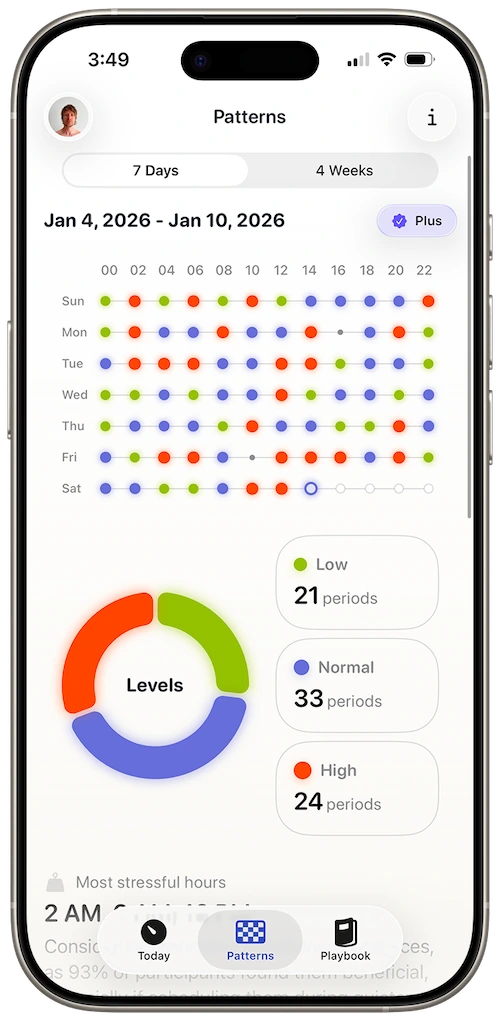
You can see your heart rate on your Apple Watch. You can't see your stress.
Heart rate is a symptom. HRV and sleep patterns reveal whether your nervous system is coping.
Apple Watch shows heart rate in real time — useful during a workout, less useful when you’re trying to understand why Tuesday through Thursday felt like wading through mud. Heart rate alone doesn’t separate healthy activation from chronic overload.
Stress lives in the autonomic nervous system. Heart rate variability — how much beat-to-beat timing changes — reflects that system with more nuance. Apple Watch records HRV during sleep and quiet periods, storing it in Health whether you look or not.
Most stress apps either give a momentary score or a number without context. What stressed professionals need is simpler and harder: did load build gradually, is recovery keeping pace, and is this week different from your normal — in language that doesn’t require a physiology degree.
How Apple Watch stress tracking actually works
Stress on Apple Watch: beyond heart rate spikes
Apple Watch shows heart rate in real time. Useful on a run. Less useful when you’re trying to understand why Tuesday through Thursday felt like wading through mud. Heart rate alone doesn’t separate healthy activation from chronic overload.
Stress lives in the autonomic nervous system. Heart rate variability — how much beat-to-beat timing changes — reflects that system with more nuance. Apple Watch records HRV during sleep and quiet periods into Health whether you look or not.
Why momentary stress scores fall short
A high reading at 3pm confirms what you feel. It doesn’t tell you whether today is isolated or day nine of a slide. Chronic overload accumulates quietly — slightly worse sleep, slightly lower HRV — until a normal week breaks you.
Harvee emphasises the shape of load: direction, duration, recovery following or not.
Personal baseline, not population average
What’s stressful physiologically differs person to person. Harvee learns your Apple Watch normal over two weeks, then flags meaningful deviations. The goal is one clear daily takeaway — not a wall of metrics that becomes another worry.
Practical use for professionals
If your weeks are unpredictable — deadlines, travel, caregiving — passive Apple Watch stress tracking fits better than rituals you’ll skip. Wear to sleep, open Harvee briefly, adjust sleep or load when the trend says so.
Harvee is not a medical device. It’s body wisdom for people who want data to inform rest, not replace professional care when needed.
Who this is for
This page is for you if:
- You wear your Apple Watch daily and feel stress in your body before you can name it
- You're a professional with unpredictable weeks — deadlines, travel, early calls — not a training plan
- You've checked heart rate in Health but it didn't explain why some weeks drain you more than others
- You want stress tracking that respects Apple Watch data without a second device or daily rituals
This is not for you if:
- You don't own an Apple Watch. Harvee is built entirely on Apple Watch and HealthKit.
- You want live biofeedback during meditation only. Harvee focuses on longitudinal stress patterns.
The solution
How Harvee helps
Harvee reads HRV, sleep, and heart rate from your Apple Watch and translates them into daily stress context and multi-week trends — so you see accumulation before you crash.
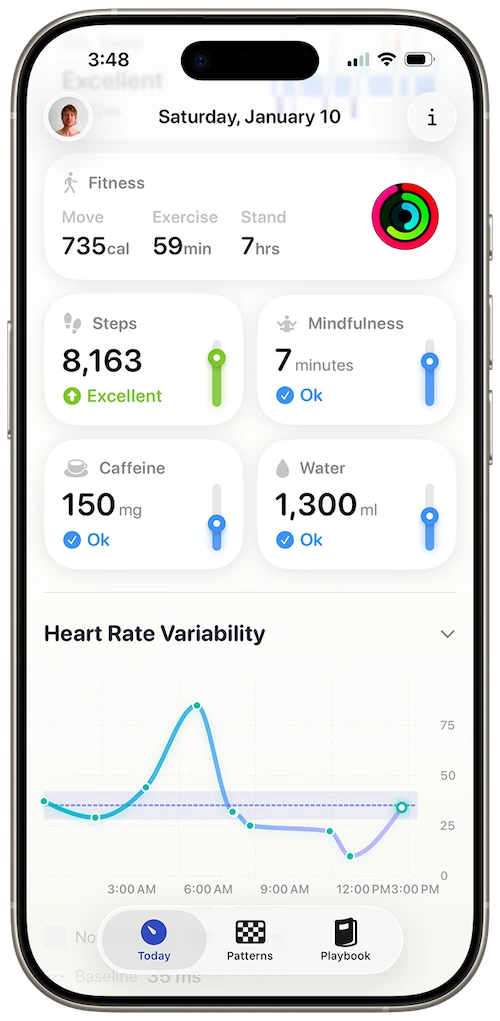
When stress started climbing — often days before you felt it
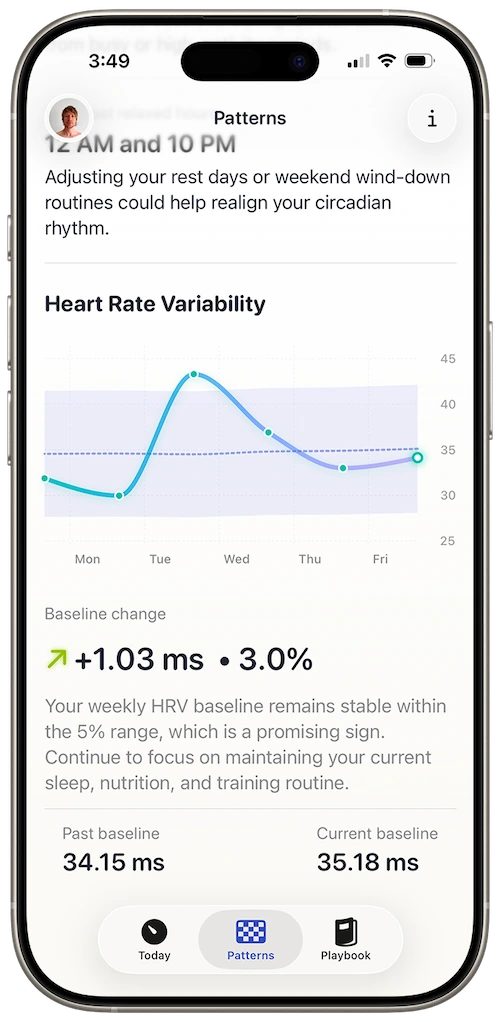
Recovery signals paired with load
Stress as a pattern
A stressful afternoon is normal. A stressful month with declining HRV is a warning. Harvee emphasises the shape of load over time.
Apple Watch passive sensing
No manual stress logs required for core insight. Your watch collects overnight HRV; Harvee interprets.
Personal baseline
Stress is relative to your physiology. Harvee learns your normal range so deviations mean something specific.
Actionable, not alarming
One clear daily read — built for people who don't want health tracking to become another source of anxiety.
Your calendar said back-to-back meetings were fine. Harvee showed HRV suppression starting Sunday night — your nervous system had been loading before the week officially began.
Common questions
Questions people ask before downloading
Will I understand the data?
Harvee is built for people who find HRV confusing. The goal is one plain-language takeaway per day, with depth available when you want it.
Is this for serious athletes or anyone?
Anyone with Apple Watch who experiences life stress — work, parenting, caregiving, study. Athletes benefit too, but Harvee is not only a training tool.
How is this different from Apple Health?
Health stores heart rate and HRV without stress framing or personal baselines. Harvee adds interpretation.
Does Apple Watch actually measure stress?
Apple Watch infers physiological stress from HRV, heart rate, and sleep — not your thoughts. Harvee makes that signal readable over weeks.
Will Harvee drain my battery?
Harvee reads data already in Health. Minimal watch impact.
App Store reviews
What people said before they tried it — and after
4.7 stars on the App Store
Beautiful app
Jan 24, 2026 — dsteshinA wonderful app that helps manage stress. Harvee the fluffy one is just a cutie.
More useful than Whoop
Dec 26, 2025 — Angie_2906I already had a Whoop and wasn't sure I needed another app. But I found Harvee tracks my stress levels more accurately in daily life - and the insights are actually actionable. I don't need the Whoop anymore.
Simpler than I expected
Jan 4, 2026 — Aaleck0I'd tried other HRV apps and found them overwhelming. Harvee is different - the insights are clear, the presentation is clean, and it actually fits into daily life without becoming another thing to manage.
Try it free
Try it. You'll know within a week.
Stress tracking should reduce guessing, not add anxiety. Try Harvee’s free Today tab for one stressful week and one calm week. If the daily takeaway doesn’t match your body, delete it. Your watch keeps logging either way.

Why we built it
Why Harvee exists
Stress isn’t a moment — it’s a pattern. Harvee was built for Apple Watch owners who need the archive, not only the alert: weeks of HRV direction that explain why this Thursday hit harder than last Thursday.
Your watch sees the signal. Harvee names the pattern.
Requires Apple Watch Series 4 or later. iPhone required.