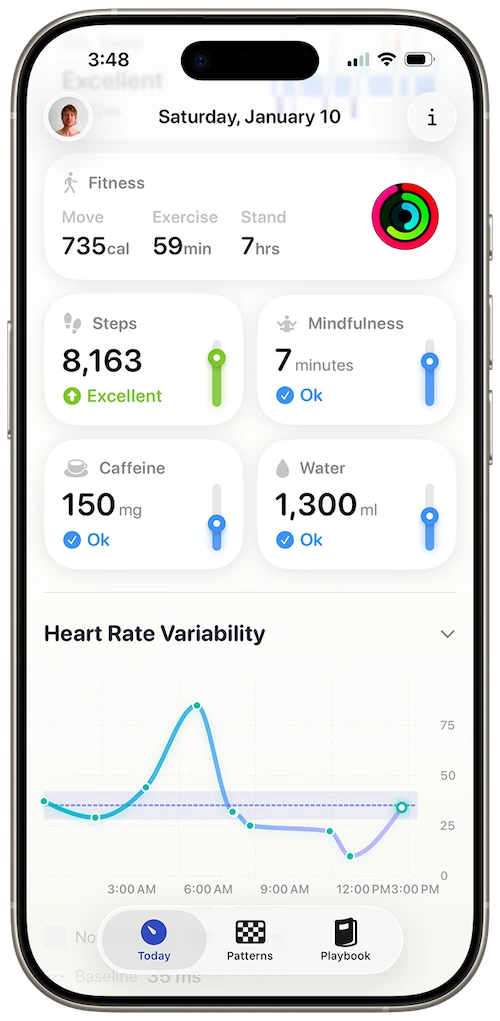
Livity tracks stress. Harvee tracks what stress is doing to your recovery.
Knowing you're stressed is step one. Knowing whether your body is still recovering from last week's stress is step two.
Livity and similar Apple Watch stress apps translate heart rate and HRV into a stress score you can check on your phone or wrist. That visibility matters — especially if you’ve never had language for what your body was doing during a difficult month.
Stress without recovery context is incomplete. Two people can show the same stress score on Tuesday; one slept eight hours with stable HRV all week, the other is on day eleven of declining overnight HRV and short sleep. The score looks similar. The physiological reality is not.
Your Apple Watch captures both sides — autonomic load and recovery signals — every night. The app you choose determines whether you see a daily mood line or a feedback loop between stress and restoration.
Daily stress scores vs recovery-aware HRV baselines
Livity vs Harvee: stress score vs stress-recovery loop
Livity-style apps answer: how stressed am I today? Red, yellow, green. Useful visibility if you’ve never had language for autonomic activation.
Incomplete when recovery is missing. Two people share a stress score; one slept eight hours with stable HRV, the other is on day eleven of suppression. The score looks similar. The bodies aren’t.
Harvee’s second question
Harvee pairs stress trends with personal HRV baselines: are you bouncing back or digging a hole? That pairing predicts burnout more reliably than stress alone.
Same sensors, different models
Both read Apple Watch heart rate and HRV via HealthKit. Livity emphasises daily scoring. Harvee emphasises 7-day and 28-day baselines with recovery framing.
Switching guidance
Switch if high stress weeks no longer surprise you but exhaustion still does. Stay if simplicity is the feature you paid for and it’s working.
Harvee is not a medical device.
Who this is for
This page is for you if:
- You wear your Apple Watch daily and have tried Livity or comparable stress-score apps
- You've been using Livity and wonder whether recovery-focused HRV baselines add something stress scores alone miss
- You see high stress readings but don't know if your body is coping or accumulating damage
- You want personal baselines, not only red-yellow-green zones based on generic ranges
This is not for you if:
- You don't own an Apple Watch. Harvee is built exclusively on Apple Watch HealthKit data.
- You only want the simplest possible stress emoji on your wrist with minimal interpretation. A lighter app may be enough.
The solution
How Harvee helps
Harvee pairs stress trend analysis with personal HRV baselines and recovery framing — so you know not only that load is high, but whether your nervous system is keeping up.
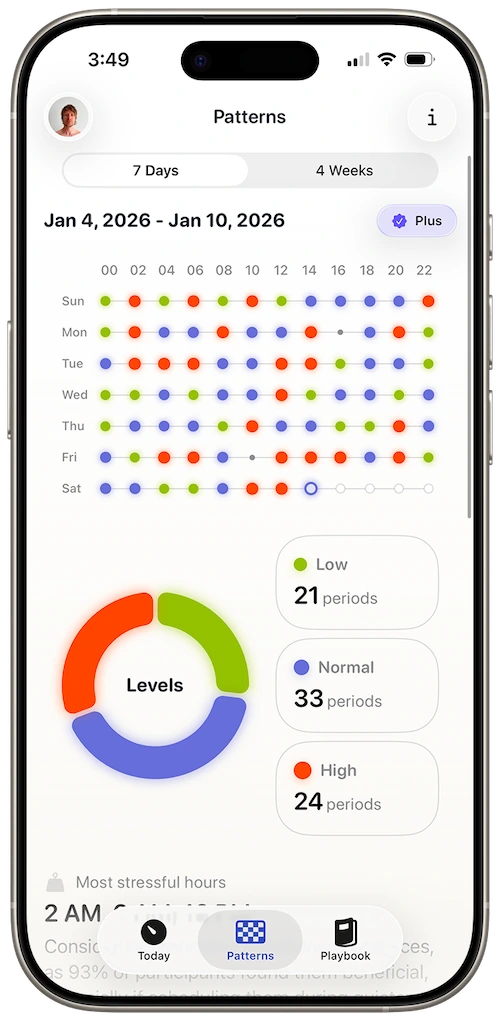
Stress distribution over a month — which days dominated
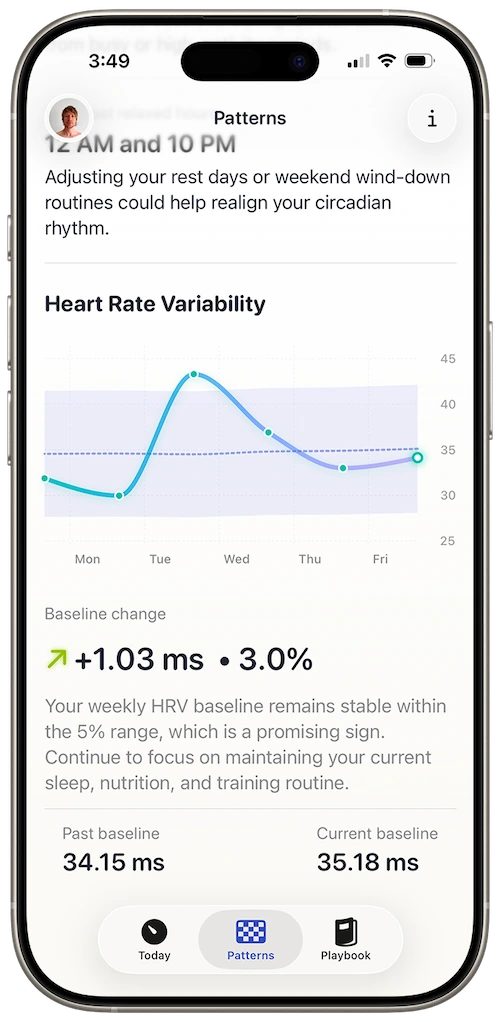
Recovery-oriented guidance when load outpaces restoration
Recovery context alongside stress
A stress score answers how activated you are. Harvee adds whether overnight HRV and sleep suggest you're bouncing back or digging a hole — the combination that predicts burnout more reliably than stress alone.
Personal HRV baseline calibration
Livity-style thresholds can feel arbitrary until they're tuned to you. Harvee spends the first weeks learning your normal HRV range so deviations mean something specific to your body.
Pattern view across 28 days
Single-day stress spikes are noisy. Harvee's Patterns tab shows how stress levels and HRV interacted across a month — the shape of a quarter, not only a afternoon.
Apple Watch-first architecture
Harvee is designed around how Apple Watch samples HRV during sleep and rest, not ported from a generic wearable model.
Livity showed elevated stress all week. You assumed that was the story. Harvee showed your HRV baseline had been below your four-week average for twelve days — you were stressed and not recovering. That explained why Friday's 'normal' workload flattened you.
Common questions
Questions people ask before switching
I've been using Livity for a while. Is it worth switching?
Livity is a capable stress tracker for Apple Watch users who want straightforward daily scores. Harvee fits when your questions shift to recovery — whether you're trending toward balance or overload across weeks. If Livity's daily view already drives the decisions you need, switching may not add much. If you feel informed but still caught off guard by crashes, Harvee's baseline model addresses that gap.
Don't both apps use the same Apple Watch data?
Similar raw inputs, different models. Livity emphasises stress scoring. Harvee emphasises HRV baselines, trend direction, and recovery pairing. Same HealthKit source, different conclusions.
Is Harvee more complicated?
Harvee aims for one clear daily takeaway. The depth lives in the Patterns tab when you want it, not on every screen by default.
How is Harvee different from Apple Health?
Health lists HRV numbers without baseline context or stress-recovery pairing. Harvee interprets relative to you over time.
Will this drain my Apple Watch battery?
Harvee reads existing HealthKit data. No additional on-watch sensor process.
App Store reviews
What people said before they tried it — and after
4.7 stars on the App Store
Beautiful app
Jan 24, 2026 — dsteshinA wonderful app that helps manage stress. Harvee the fluffy one is just a cutie.
More useful than Whoop
Dec 26, 2025 — Angie_2906I already had a Whoop and wasn't sure I needed another app. But I found Harvee tracks my stress levels more accurately in daily life - and the insights are actually actionable. I don't need the Whoop anymore.
Simpler than I expected
Jan 4, 2026 — Aaleck0I'd tried other HRV apps and found them overwhelming. Harvee is different - the insights are clear, the presentation is clean, and it actually fits into daily life without becoming another thing to manage.
Try it free
Try it. You'll know within a week.
If Livity’s daily stress score already changes how you pace your day, switching may add little. Try Harvee when you feel informed but still surprised by crashes — seven nights free on Today tab shows whether recovery context was the missing piece.

Why we built it
Why Harvee exists
Stress tracking tells you the weather at noon. Recovery-aware HRV baselines tell you whether the ground is flooding.
Harvee exists for Apple Watch owners who need both signals in one readable story.
Apple recognised Harvee as a Design Awards Finalist for Social Impact. Not for how it looks. For what it does to people’s lives.
| Harvee | Livity | |
|---|---|---|
| Measurement method | HRV baselines + stress trends | Heart rate / HRV stress scoring |
| Data continuity | 28-day pattern and recovery framing | Daily stress emphasis |
| Apple Watch integration | Baseline-personalised HealthKit model | Stress score from watch sensors |
Track stress. Understand recovery. Same Apple Watch.
Requires Apple Watch Series 4 or later. iPhone required.