Welltory shows you your HRV score. Then what?
A score without context is just a number. Here's what Apple Watch HRV tracking looks like when it actually helps you make decisions.
You open the app. You see a number. Maybe an energy score, a stress score, a focus score. You nod. You close the app. And by mid-afternoon you’ve forgotten what any of it meant.
That’s not a Welltory problem specifically. It’s the problem with how most HRV apps are built: they give you a reading, not a story. They show you where you are, not what got you there or what’s coming.
Your Apple Watch is collecting HRV data every night while you sleep. It captures it during the day when you’re stressed, recovering, or somewhere in between. That data is sitting in Apple Health right now — days, weeks, months of it. The question isn’t whether you have enough data. The question is whether anyone is helping you read it.
Welltory's camera protocol vs passive Apple Watch HRV
Welltory vs Harvee: episodic precision vs continuous patterns
Welltory built a loyal audience around a specific ritual: camera on the fingertip, controlled breathing, a clean HRV reading in known conditions. That protocol produces precise snapshots — excellent when you do it every day at the same time.
Life interrupts rituals. Travel, children, early meetings, the morning you forget. Each missed session is a gap in the chart. Harvee’s model assumes gaps happen and leans on Apple Watch background HRV instead — noisier per reading, continuous across nights.
Same Health data, different philosophy
Welltory can import Apple Health. Its centre of gravity remains the measurement you perform. Harvee’s centre of gravity is the measurement your watch already performed while you slept. Both are valid. The choice is which failure mode you prefer: imprecise continuity or precise intermittency.
For stress accumulation over weeks — the slow slide before burnout — continuity often wins. For biofeedback during breathing practice, Welltory’s approach may still be better.
What Harvee adds for Apple Watch natives
Harvee is Apple Watch-first: understands HealthKit sampling, weights overnight windows, builds personal baselines without cross-platform compromise. If your wrist is Apple-only and your question is “what has my nervous system been doing,” Harvee is tuned for that.
Honest switching advice
Don’t switch because Harvee is “better” in abstract. Switch if the camera ritual stopped fitting and you still want HRV to mean something. Keep Welltory if the ritual is the point and gaps don’t bother you.
Harvee is not a medical device. Use either app as wellness context, not diagnosis.
Who this is for
This page is for you if:
- You wear your Apple Watch daily and already open the Health app occasionally
- You've been using Welltory or are considering it, and want to know how it compares to something built specifically for Apple Watch
- You've seen your HRV number and genuinely don't know whether 38ms is good or worrying for you specifically
- You've had stretches — a bad week, a run of poor sleep, a high-pressure period — and only realised in hindsight that your body was struggling before you felt it
This is not for you if:
- You don't own an Apple Watch. Harvee is built entirely around Apple Watch data and HealthKit — if you use a Garmin, Oura, or Whoop as your primary tracker, Harvee won't be useful to you.
- You want real-time HRV biofeedback during breathing exercises. Welltory is better suited for that specific use case.
The solution
How Harvee helps
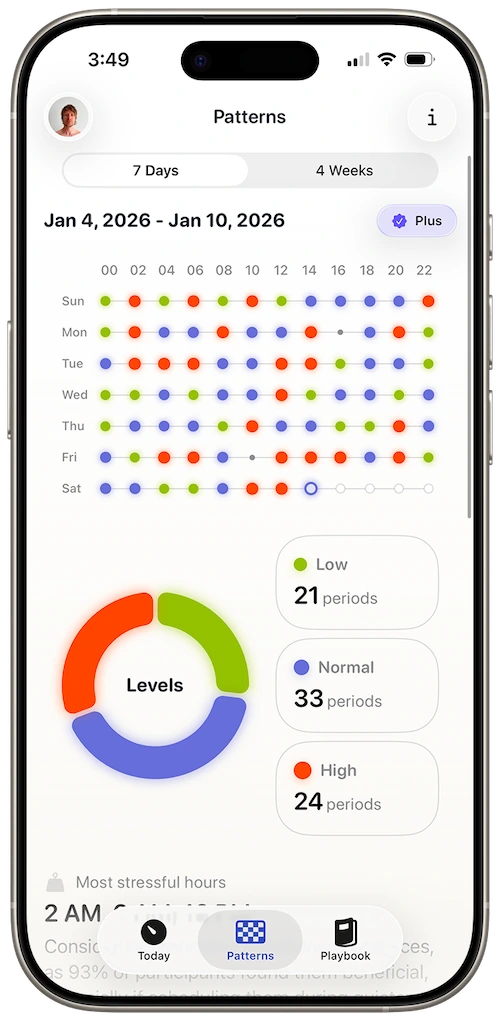
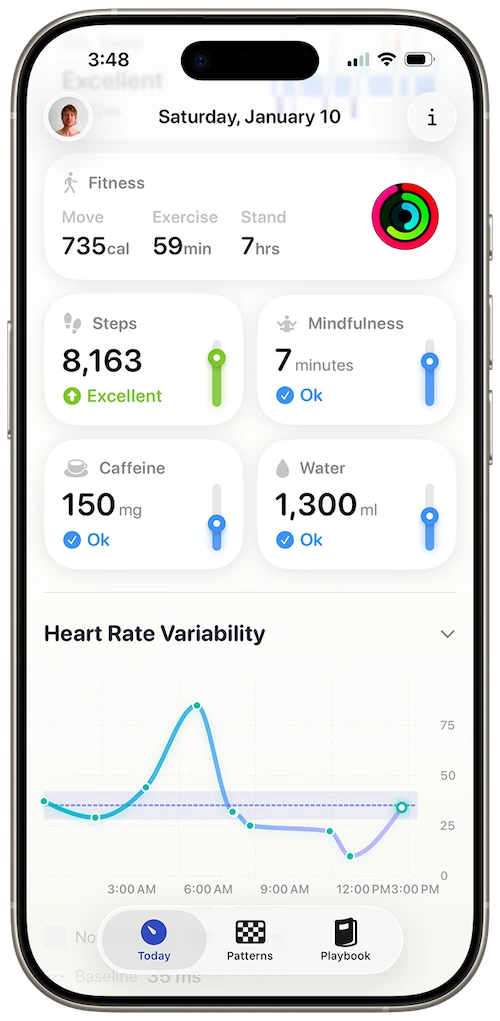
Harvee reads the HRV data your Apple Watch already collects — passively, in the background — and turns it into a rolling picture of how your nervous system responds to stress and recovery over time. No manual measurement. No holding your phone camera to your fingertip. No extra hardware.
See when your stress load started climbing — often days before you felt it
Morning readiness based on your personal baseline, not a population average
Pattern recognition, not daily scores
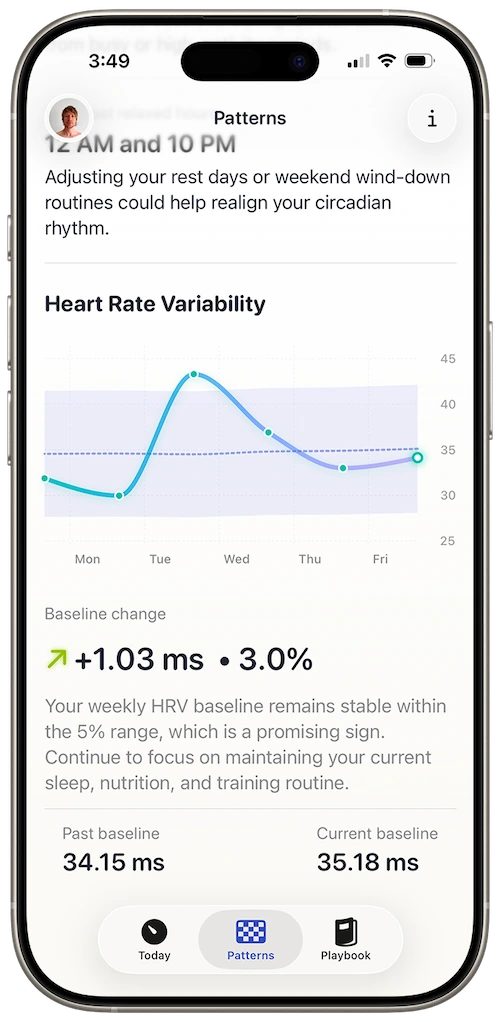
A single HRV reading tells you almost nothing. Your HRV the morning after two glasses of wine looks identical to your HRV during early-stage burnout. Harvee tracks the direction and duration of change — the pattern — which is what actually predicts how your body is coping.
Your baseline, not someone else's
An HRV of 42ms might be healthy for you and worrying for someone else. Harvee establishes your personal baseline over time and measures everything relative to that. The number matters less than what it means for you.
Always-on, no ritual required
Welltory's camera-based measurement is precise but requires a daily habit — if you miss a day, you have a gap. Harvee reads from Apple Watch's background HRV collection, so your data is continuous whether you remember to open the app or not.
Built for Apple Watch, not adapted to it
Harvee is designed specifically for the HealthKit data model. It understands how Apple Watch samples HRV, when those readings are most reliable, and how to weight them. It's not a cross-platform app that also supports Apple Watch — it's an Apple Watch app, full stop.
You're three days into what feels like a manageable but heavy week. You check Harvee and see your HRV has been trending down for nine days — starting the week before this one. Your body wasn't just responding to this week's pressure. It was already compromised going in. That's why Thursday felt so much harder than it should have.
Common questions
Questions people ask before switching
I've been using Welltory for a while. Is it worth switching?
Depends what you're looking for. Welltory is excellent at what it does — particularly the manual measurement protocol, which produces very clean readings, and the research integrations. If you value those specifically, Welltory is probably the right tool. Where Harvee differs: entirely passive, Apple Watch-native, focused on trends over time rather than daily scores. If the daily measurement ritual has stopped fitting your life, or you want patterns rather than snapshots, that's where Harvee tends to fit better.
Welltory also reads from Apple Health. What's the difference?
Welltory can read Apple Health data, but its core method is the camera protocol — a focused session that captures a clean reading in controlled conditions. This is precise but episodic. Harvee's entire model is built around the background HRV readings Apple Watch generates throughout the day and night. Less precise per reading, but a continuous view of how your autonomic nervous system is behaving across hours and days. Different methodology, different kind of insight.
How is Harvee different from just looking at HRV in the Apple Health app?
Apple Health shows raw HRV numbers with no interpretation. It doesn't know if your 38ms today is high or low for you. It doesn't surface trends or distinguish between a good HRV drop (post-workout) and a concerning one (accumulated stress). Harvee adds the context: your personal baseline, trend direction, and the pattern of change over time. The difference between a thermometer and a weather forecast.
Will this drain my Apple Watch battery?
Harvee reads from data Apple Watch has already collected — it doesn't run its own background sensors. Battery impact is minimal.
I'm not a biohacker. Will I actually understand this?
Harvee is built for people who find HRV confusing, not for people who already love it. The goal is one clear takeaway per day, not a wall of metrics. If you've felt overwhelmed by health data before, that's the problem Harvee is designed to solve.
App Store reviews
What people said before they tried it — and after
4.7 stars on the App Store
Beautiful app
Jan 24, 2026 — dsteshinA wonderful app that helps manage stress. Harvee the fluffy one is just a cutie.
More useful than Whoop
Dec 26, 2025 — Angie_2906I already had a Whoop and wasn't sure I needed another app. But I found Harvee tracks my stress levels more accurately in daily life - and the insights are actually actionable. I don't need the Whoop anymore.
Simpler than I expected
Jan 4, 2026 — Aaleck0I'd tried other HRV apps and found them overwhelming. Harvee is different - the insights are clear, the presentation is clean, and it actually fits into daily life without becoming another thing to manage.
Try it free
Try it. You'll know within a week.
If Welltory’s daily camera ritual still fits your morning, keep it. Try Harvee alongside for two weeks without deleting anything — compare whether passive Apple Watch trends catch dips your episodic readings miss. Harvee’s Today tab is free.
Walk away if patterns don’t add clarity. No hardware lock-in either way.

Why we built it
Why Harvee exists
Most HRV apps were built to answer the question: what is my HRV right now? Harvee was built to answer a different question: what has my nervous system been doing, and why does it matter for how I feel today?
A single number, even an accurate one, doesn’t tell you whether you’re heading into a wall or climbing out of one. The pattern does. The context does. The ability to look back at a hard week and see that your body knew it was coming — that does.
Harvee is the only Apple Watch stress app built specifically around pattern recognition over time, using your personal baseline, read from the data your Apple Watch is already collecting. Not a score. Not a snapshot. A story your body is telling, made readable.
Apple recognised Harvee as a Design Awards Finalist for Social Impact. Not for how it looks. For what it does to people’s lives.
| Harvee | Welltory | |
|---|---|---|
| Measurement method | Passive Apple Watch background HRV | Camera fingertip protocol (optional Health import) |
| Data continuity | Continuous daily readings without user action | Episodic; gaps when you skip a session |
| Apple Watch integration | Native HealthKit-first design | Cross-platform; Apple Watch is one input among many |
Your Apple Watch already has the data. Harvee helps you read it.
Requires Apple Watch Series 4 or later. iPhone required.