Whoop costs £30/month and requires a second device. Your Apple Watch already has the data.
Recovery scores are useful. So is not wearing two devices and paying for data your watch already collects.
WHOOP built a category: strap-based HRV, sleep staging, strain scores, and a recovery number that tells you how hard to push today. For people who live inside that ecosystem, it’s coherent and polished.
The tradeoffs are structural. A monthly subscription. A second device on your wrist or bicep. A data silo that doesn’t always play nicely with the Apple Watch you already wear for everything else.
Apple Watch Series 4 and later records HRV during sleep, tracks heart rate and activity, and syncs to Health. That is not a worse sensor array for everyone — it’s a different business model. You paid for the watch once. The question is whether you need a parallel subscription to interpret what it already stores.
WHOOP vs Apple Watch HRV — what you're actually comparing
WHOOP vs Harvee: two business models, one question
WHOOP and Harvee both try to answer whether your body can handle today’s load. They diverge on hardware, data path, and what “recovery” looks like on screen.
WHOOP optimises for a dedicated strap: continuous HRV, strain score, sleep staging, recovery percentage, community features. You pay monthly for hardware access and cloud interpretation. The workflow is polished if you’re all-in on the ecosystem.
Harvee optimises for the Apple Watch already on your wrist: passive overnight HRV via HealthKit, personal baselines, stress-recovery trends across weeks. No second device. Today and Playbook free; Harvee+ for deep Patterns.
Accuracy vs continuity
WHOOP’s strap often wins on per-reading precision for HRV-focused athletes. Apple Watch wins on frictionless continuity — data every night you sleep with it on, integrated with the rest of your health archive. Harvee bets that for lifestyle stress and burnout prevention, the multi-week pattern matters more than the cleanest single morning sample.
That’s not saying WHOOP is wrong for its audience. It’s saying the question changes when you’re a professional wearing Apple Watch daily who doesn’t want a parallel subscription.
Who should switch, who should stay
Stay on WHOOP if you love the strain league, bicep form factor, and recovery number as daily ritual. Consider Harvee if you forgot to charge the strap again, want data in Health you own, or care more about ten-day HRV slides than today’s percentage.
Many ex-WHOOP users run a two-week overlap: both apps, compare trends, then drop the subscription when Apple Watch + Harvee tells the same story.
The consolidation argument
Two devices means two charge routines, two sync paths, two places your data lives. Consolidating on Apple Watch + Harvee is a lifestyle decision as much as a financial one — fewer moving parts, same autonomic question.
Harvee is not a medical device. Neither is WHOOP. Use either as wellness input, not as a substitute for clinical care when you need it.
Who this is for
This page is for you if:
- You wear your Apple Watch daily and want recovery insight without a second wearable
- You've been using WHOOP and are evaluating whether Apple Watch-native tracking covers your needs
- You want stress and HRV trends without another monthly hardware subscription
- You prefer keeping health data in Apple's ecosystem rather than a third-party strap platform
This is not for you if:
- You don't own an Apple Watch. Harvee requires Apple Watch Series 4 or later.
- You want WHOOP's social teams, strain league, and bicep-strap form factor. Harvee does not replicate that community layer.
The solution
How Harvee helps
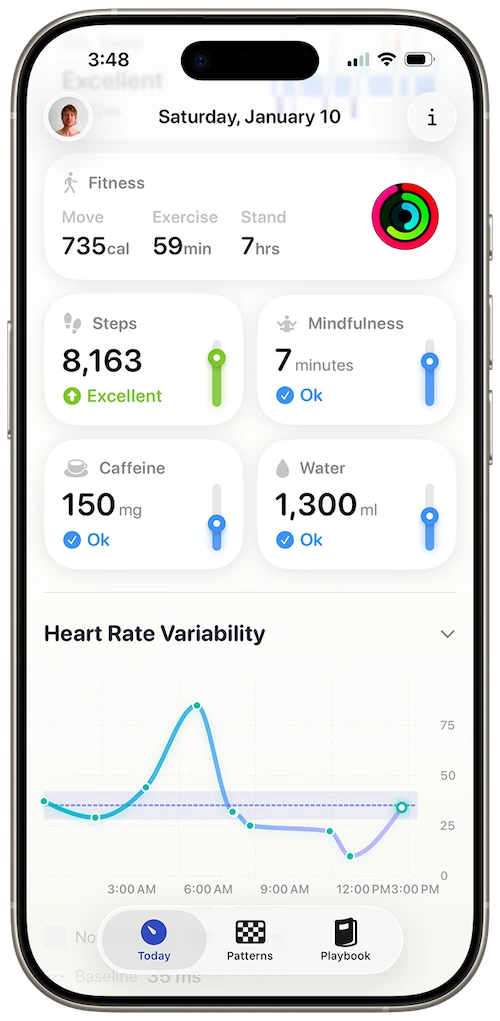
Harvee reads HRV, sleep, and activity from your Apple Watch via HealthKit — personal baselines, stress trends, and recovery guidance without a second device or WHOOP membership.
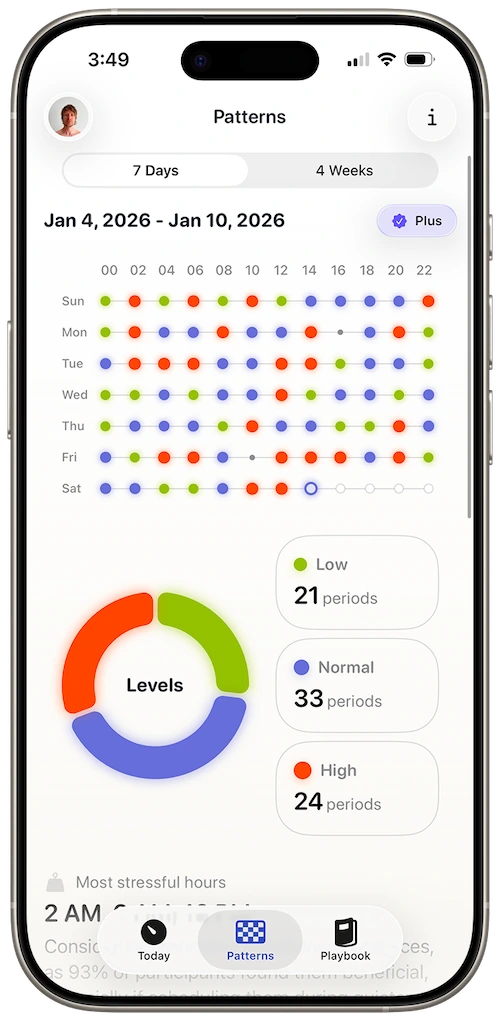
Monthly stress distribution — which weeks dominated
Daily stress view on iPhone using data your watch already collected
No extra hardware
WHOOP requires the strap. Harvee uses the Apple Watch on your wrist today. One device, one charging routine, one ecosystem.
Core insight without mandatory subscription
Harvee's Today and Playbook tabs are fully available free. Deep pattern analytics unlock with Harvee+ — a different price point than WHOOP's hardware-plus-membership model.
HealthKit-native data ownership
Your HRV and sleep live in Apple Health. Harvee reads them there. You're not locked into a proprietary cloud as the only archive.
Stress patterns, not only a recovery percentage
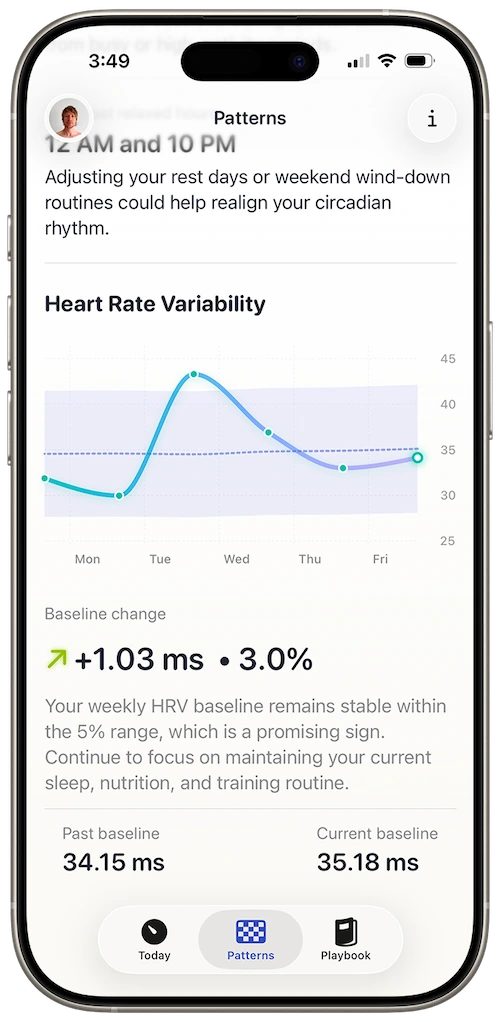
WHOOP's recovery score is familiar. Harvee emphasises how stress and HRV trend across weeks — the shape of overload before the score turns red.
You forgot to charge the WHOOP strap. Your Apple Watch still logged overnight HRV. Harvee showed the same downward trend WHOOP would have — from the device you never took off.
Common questions
Questions people ask before switching
I've been using WHOOP for a while. Is it worth switching?
WHOOP is strong if you love the strap form factor, strain score, and community features and you're happy paying monthly. Harvee fits when you want to consolidate on Apple Watch, reduce subscriptions, and still see HRV-based stress and recovery trends. Many ex-WHOOP users miss the single recovery number at first; they stay for the pattern view and one-device simplicity.
Is Apple Watch as accurate as WHOOP?
WHOOP optimises for continuous wrist/bicep HRV. Apple Watch optimises for sleep-window HRV and integration with the rest of your health data. For trend detection and lifestyle stress monitoring, watch data is widely considered sufficient — not identical, but actionable.
What about WHOOP's sleep tracking?
Harvee uses Apple Watch sleep data via HealthKit. If you already trust Apple sleep stages for your decisions, Harvee layers stress and HRV interpretation on top. If WHOOP's sleep model is your reference standard, compare both during a trial week.
Will I lose the recovery score?
Harvee frames recovery through HRV baselines and stress trends rather than a single branded percentage. Different interface, similar underlying question: can my body handle today's load?
Will Harvee drain my Apple Watch battery?
Harvee reads data already in Health. No additional strap required.
App Store reviews
What people said before they tried it — and after
4.7 stars on the App Store
Beautiful app
Jan 24, 2026 — dsteshinA wonderful app that helps manage stress. Harvee the fluffy one is just a cutie.
More useful than Whoop
Dec 26, 2025 — Angie_2906I already had a Whoop and wasn't sure I needed another app. But I found Harvee tracks my stress levels more accurately in daily life - and the insights are actually actionable. I don't need the Whoop anymore.
Simpler than I expected
Jan 4, 2026 — Aaleck0I'd tried other HRV apps and found them overwhelming. Harvee is different - the insights are clear, the presentation is clean, and it actually fits into daily life without becoming another thing to manage.
Try it free
Try it. You'll know within a week.
Ex-WHOOP users often miss the single recovery number for the first week. Give Harvee fourteen nights on Apple Watch before judging — baselines need time. The free Today tab shows daily direction without paying for Harvee+ or buying new hardware.
If you still want the strap community, keep WHOOP. If you want consolidation and pattern view, Harvee costs nothing to try.

Why we built it
Why Harvee exists
WHOOP sells a subscription to a strap. Harvee sells interpretation to data Apple Watch already owns.
If your wrist is Apple-shaped, Harvee is built for that constraint — not as a compromise, as a design choice. One device, one charge routine, one Health archive you control.
Apple recognised Harvee as a Design Awards Finalist for Social Impact — for what it does to people’s lives, not for feature checklists.
| Harvee | WHOOP | |
|---|---|---|
| Measurement method | Apple Watch via HealthKit | WHOOP strap (second device) |
| Data continuity | Nightly HRV from watch you already wear | Strap-dependent; separate charge cycle |
| Apple Watch integration | Native; single-device workflow | Parallel ecosystem; partial Health sync |
One watch. Your data. No second subscription required to start.
Requires Apple Watch Series 4 or later. iPhone required.